


 PLATFORM UPDATE:


In situ synthesis of bioorthogonally catalyzed drugs based on hydrogen-bonded organic frameworks for cancer therapy
 a
Maolin
Pang
*a
a
Maolin
Pang
*a
Abstract
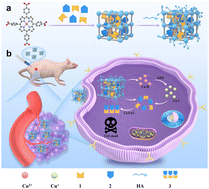
As one of the most representative bioorthogonal reactions, the copper(I)-catalyzed azide–alkyne cycloaddition (CuAAC) reaction has attracted considerable attention in biomedical applications, attributed to its high efficiency and selectivity for the in situ synthesis of drugs within tumor cells. However, effectively achieving tumor-targeted drug activation through the CuAAC reaction still remains a major challenge, and an efficient delivery system is also needed for the prodrugs to avoid the rapid metabolism within biological environments. In this study, the inactive prodrug precursors were encapsulated within hydrogen-bonded organic framework (HOF) nanoparticles, and then selectively activated in the tumor microenvironment via an intracellular CuAAC reaction. The in situ formed drugs could effectively kill the cancer cells and suppress tumor growth. This strategy enables precise, in situ synthesis of active drug molecules within cancer cells, thereby achieving targeted therapeutic activation while minimizing off-target toxicity to normal tissues and cells.
 Please wait while we load your content...


