


The omics revolution in obesity: from molecularsignatures to clinical solutions
 a
Amr A.
Arafat,
ac
Waleed
Alhazzani,
ad
Faisal
Kunnathodi,
a
Sarfuddin
Azmi,
a
Riyasdeen
Anvarbatcha,
a
Ishtiaque
Ahmad
a
and
a
Amr A.
Arafat,
ac
Waleed
Alhazzani,
ad
Faisal
Kunnathodi,
a
Sarfuddin
Azmi,
a
Riyasdeen
Anvarbatcha,
a
Ishtiaque
Ahmad
a
and
Abstract
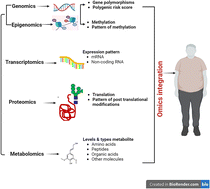
Obesity is a multifactorial condition projected to affect over half of the global population by 2035, posing significant clinical and socioeconomic challenges. Traditional metrics such as body mass index lack precision in predicting individual risk, disease progression, and therapeutic response due to the heterogeneous nature of obesity. Advances in omics technologies such as genomics, epigenomics, transcriptomics, proteomics, and metabolomics have enabled the identification of molecular subtypes and candidate biomarkers that offer deeper insights into obesity pathophysiology. Genomic studies have revealed hundreds of loci associated with obesity related traits, while polygenic risk scores offer modest improvements in early risk prediction. Epigenomic profiling, particularly deoxy ribose nucleic acid (DNA) methylation signatures such as those at carnitine palmitoyl transferase 1A (CPT1A) and hypoxia inducible factor 3 subunit alpha (HIF3A), has uncovered modifiable pathways linked to adiposity and metabolic dysfunction. These findings are increasingly being integrated with other omics layers to improve stratification and therapeutic targeting. Metabolomic subtypes, including ceramide driven insulin resistance and branched chain amino acid (BCAA) dominant dysregulation, have shown potential in guiding treatment selection, such as sodium glucose cotransporter 2 (SGLT2) inhibitors or glucagon like peptide-1 (GLP-1) agonists. Proteomic markers like proprotein convertase subtilisin/kexin type 9 (PCSK9) and retinol binding protein 4 (RBP4) are being evaluated for cardiovascular risk stratification independent of body mass index (BMI). Integrative multiomics frameworks and AI driven models are beginning to bridge molecular data with clinical phenotypes, enabling patient stratification and risk modeling. However, most findings remain in research grade environments, and clinical translation is limited by cohort diversity, data harmonization challenges, and the lack of standardized validation protocols. This review synthesizes evidence from single and multiomics studies, highlights emerging biomarkers and molecular subtypes, and discusses the potential of omics guided frameworks to inform precision obesity care.
 Please wait while we load your content...