


Zinc gluconate as a multifunctional electrolyte additive for dendrite-free and long-life zinc ion batteries

Abstract
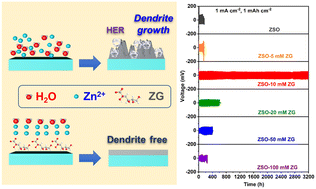
Aqueous zinc ion batteries (AZIBs) have attracted much attention owing to their low cost, high capacity and superior safety, but dendrite growth, hydrogen evolution and corrosion reaction hinder their applications. Herein, zinc gluconate (ZG) is introduced as an effective additive to the frequently used ZnSO4 electrolyte in AZIBs. Particularly, there are rich oxygen-containing functional groups in ZG, such as hydroxyl groups, which can promote the preferential ZG adsorption and subsequent dispersion of zinc ions on the electrode interface. Consequently, partially concentrated zinc metal electroreduction can be well suppressed, and the hydrogen evolution reaction (HER) and fatal corrosion are also effectively alleviated due to the isolation of free water and sulfate anions. In addition, ZG addition improves the electrochemical properties of AZIBs. Symmetric zinc batteries achieve ultra-long and stable capabilities of over 3200 h and 1000 h at 1 mA cm−2 (1 mAh cm−2) and 3 mA cm−2 (3 mAh cm−2), respectively. Asymmetric cells exhibited an ultra-high average coulombic efficiency of 99.8% for 400 cycles at 5 mA cm−2 and 3 mAh cm−2. The full battery using NH4V4O10 exhibits excellent cycling stability and higher capacity retention. This study can provide a reference for developing highly stable electrolytes for AZIBs.
 Please wait while we load your content...


