


 PLATFORM UPDATE:


Metal–organic framework-derived ultra-microporous bismuth oxide synchronizing energy density and stability in symmetric supercapacitors
 a
Majid
Khan
*e
a
Majid
Khan
*e
Abstract
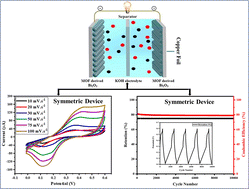
The development of bismuth oxide (Bi2O3) for supercapacitor applications is often limited by its intrinsically low electrical conductivity and structural instability during cycling. Herein, a metal–organic framework (MOF)-derived strategy is employed to engineer ultra-microporous Bi2O3 architectures with tailored structural and electrochemical properties. Through a controlled solvothermal synthesis followed by calcination using terephthalic acid as an organic linker, a hierarchically porous Bi2O3 structure is obtained with an enhanced surface area of 117 m2 g−1 and dominant ultra-micropores centered at 0.42 nm. The engineered porous framework promotes efficient electrolyte infiltration and improves redox accessibility, resulting in a high specific capacitance of 876 F g−1 at 0.5 A g−1 in a three-electrode configuration. When assembled into a symmetric two-electrode supercapacitor operating within a 0–0.6 V window, the MOF-derived Bi2O3 electrode delivers a device-specific capacitance of 950 F g−1, achieving a maximum energy density of 47.2 Wh kg−1 at a power density of 150 W kg−1. The device maintains 75.3% capacitance retention after 10 000 charge/discharge cycles with a coulombic efficiency of 81.4%. These findings demonstrate that MOF-assisted structural engineering effectively enhances ion transport pathways and electroactive surface utilization, offering a viable strategy for improving the electrochemical performance of metal oxide-based supercapacitors.
 Please wait while we load your content...


