


 PLATFORM UPDATE:


Modeling the photovoltaic characteristics of Zr-doped TiO2 dye-sensitized solar cells by incorporating CNT@TiO2

Abstract
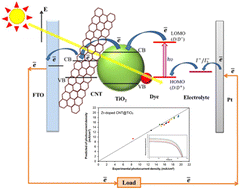
Using a diffusion differential model, this paper presents models that have been developed to predict the photovoltaic characteristics of Zr-doped TiO2 dye-sensitized solar cells (DSSCs) by incorporating a CNT–TiO2 core–shell (CNT@TiO2) with mono- and double-layer photoanode configurations. The monolayer cells are composed of Zr-doped TiO2 nanoparticles with different molar concentrations of Zr, while the double-layer devices are composed of Zr-doped TiO2 nanoparticles with optimum Zr content (i.e., 0.025 mol%) as the under-layer and CNT@TiO2, with varying CNT weight content, as the over-layer. The model evaluates the impact of critical parameters, including Zr concentration, CNT@TiO2 content, operating temperature, and photoanode thickness, on the photovoltaic characteristics of the devices. The model predictions are validated, demonstrating their capability to accurately represent the photocurrent density–voltage behavior of the devices. Results indicate that the photocurrent density of monolayer DSSCs increases with increasing Zr content up to 0.025 mol% and then decreases with further increases in Zr molar percentage. Moreover, both photocurrent density and open-circuit voltage of the double-layer devices first increase with the introduction of CNT@TiO2 and then decrease, reaching the highest value at 0.025 wt%. It is found that high operating temperatures lead to a decrease in the open-circuit voltage for all photoanode thicknesses, while the photocurrent density first increases with an increase in operating temperature and then decreases with a further temperature increase, reaching a maximum at 30 °C. For monolayer DSSCs, photocurrent density increases with electrode thickness up to 15 µm, after which it declines. These findings present essential knowledge for optimizing the design and efficiency of DSSCs.
 Please wait while we load your content...


