


 PLATFORM UPDATE:

Dynamic eco-techno-economic analysis of low-carbon hydrogen production from methane
 *ab
*ab
Abstract
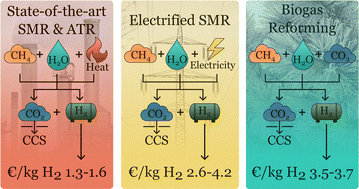
Hydrogen is currently produced predominantly through fossil fuel reforming, which accounts for approximately 3% of annual global CO2 emissions. To reduce the carbon intensity of hydrogen production, several low-carbon alternatives have been proposed, including biogas reforming and electrified steam methane reforming (e-SMR). Biogas benefits from its biogenic origin, leading to near net-zero carbon emissions, while e-SMR replaces the natural gas combustion used for reactor heating in conventional SMR with electrical heating. This modeling study performs a dynamic techno-economic assessment of these processes in comparison with state-of-the-art steam methane reforming (SMR) and auto-thermal reforming (ATR), evaluating the impact of implementing carbon capture and permanent storage (CCS). The analysis incorporates time-resolved and seasonal variations of real electricity prices in French, Swiss and German scenarios, employed as reference cases for low and high electricity grid footprints. Large-scale SMR and ATR plants exhibit the highest process efficiency (79–81%), which remains stable when CCS is implemented (77–81%). Lower efficiencies are observed for biogas reforming (56–67% with base case and 65–69% with CCS) and e-SMR (59% with base case and 71% with CCS) due to their smaller scale and the presence of CO2 in the feed. CCS significantly reduces carbon footprints: from 8.6–8.7 to 1.2–3.4 kgCO2 kgH2−1 for SMR and ATR and from 0.2–1.0 to −10 to −4 kgCO2 kgH2−1 for biogas reforming. e-SMR emissions (from 6–18 to 0.3–10 kgCO2 kgH2−1 with CCS) depend strongly on the electricity mix. The possible presence of carbon credits makes the application of CCS economically beneficial for SMR and ATR (H2 cost ranging from 1.6 to 1.3 € per kgH2) and for biogas reforming (from 3.7 to 3.5 € per kgH2). e-SMR competitiveness is highly electricity-price-dependent and benefits from CCS regardless of carbon credits, performing best in France (3.7 to 2.6 € per kgH2 with CCS) and worst in Switzerland (4.2 to 3.1 € per kgH2 with CCS). Intermittent operation to exploit low-cost electricity may further reduce e-SMR costs by 0.1–0.4 € per kgH2.
- This article is part of the themed collections: Energy Advances Recent HOT Articles, Research advancing UN SDG 7: Affordable and clean energy, Research advancing UN SDG 13: Climate Action and Research advancing UN SDG 12: Responsible consumption and production
 Please wait while we load your content...


