


 PLATFORM UPDATE:


Enhanced Cr(vi) removal and power generation in tannery wastewater using ORR-optimized cathodes in single-chamber microbial fuel cells

Abstract
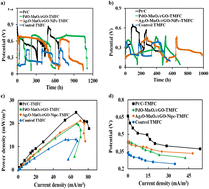
The environment and human health are seriously threatened by hazardous heavy metals, including hexavalent chromium [Cr(VI)], due to its toxicity and mobility. Single-chamber microbial fuel cells (MFCs) offer a simple, cost-effective configuration and an emerging technology for bioremediation of Cr(VI)-containing tannery wastewater into renewable energy. This study proposes a straightforward strategy to enhance Cr(VI) bioremediation and electricity generation in MFCs treating real tannery wastewater. This approach involves optimizing the anodic biofilm to sustain organic degradation under high Cr(VI) concentrations and developing low-cost, highly active oxygen reduction reaction (ORR) cathodes to replace precious metal catalysts such as Pt/C. In the optimized configuration, the MFCs achieved a Cr(VI) removal efficiency of 93.05 ± 2.35, 90.14 ± 5.8, 85.83 ± 4.8, and 73.61 ± 5.53% with a Coulombic efficiency of 37.09 ± 4.85, 31.04 ± 3.08, 26.74 ± 3.16, and 21.1 ± 23.29% for Pt/C, Ag2O–MnO2/rGO–NiPc, PdO–MnO2/rGO, and control MFC, demonstrating the system's strong environmental performance. Additionally, tannery MFCs (TMFCs) equipped with Pt/C and Ag2O–MnO2/rGO–NiPc cathodes exhibited relatively higher power output (i.e., 24.76 and 21.14 mW m−3, respectively) compared with PdO–MnO2/rGO–TMFC (19.94 mW m−3) and the control TMFC (13.21 mW m−3). These findings offer a promising strategy for effective chromium remediation in treating tannery wastewater streams.
 Please wait while we load your content...


