


 PLATFORM UPDATE:


GREENcell – combination of a strain-hardened and passivated Al alloy foil anode with a F-free LiMn2O4 cathode
 *a
*a
Abstract
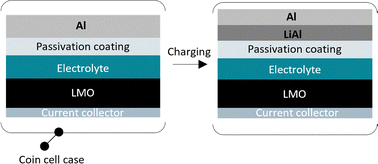
The rapid growth of lithium-ion battery (LiB) production calls for chemistries that combine high energy density with low environmental and economic impact. The GREENcell-concept addresses this challenge by pairing a fluorine (F)-free polyisobutylene (PIB) binder-based LiMn2O4 (LMO) cathode with an anode based on commercial aluminum (Al) alloy foil, whose theoretical capacity (993 mAh g−1) far exceeds that of graphite (372 mAh g−1). In this study cycling stability was improved through iterative optimization of the GREENcell-concept, targeting cathode formulation as well as Al foil composition, Al foil hardness, and Al surface passivation. Substituting polyvinylidene fluoride (PVDF)-based commercial LMO with a F-free PIB-based formulation reduced cathodic capacity fade by 17%, yet ∼20% of total losses in the full-cell set up remained cathode-related. To evaluate anode optimization strategies, full-cells incorporating the F-free LMO cathode were employed. Al alloy 8011 containing iron and silicon impurities outperformed high-purity Al 1050 reference foil, improving capacity retention by ∼10% through more uniform lithiation, while strain-hardened foils effectively suppressed plastic deformation compared with annealed counterparts. Surface passivation of the 8011 Al alloy foil provided further gains: a chrome(III)-based passivation improved capacity retention by 11%, and an Al silicate layer enabled the most durable cell performance, maintaining a stable capacity profile for 100 cycles after the initial losses were overcome, likely by promoting a robust solid–electrolyte interface (SEI) able to accommodate anode volume changes. Collectively, these strategies increased capacity retention after 100 cycles from 4% for uncoated annealed high-purity Al 1050 foil to 67% for the strain-hardened, Al silicate-passivated 8011 Al alloy foil, demonstrating GREENcell's promise as a scalable, low-cost, and environmentally benign LiB architecture, as demonstrated in laboratory coin cells.
 Please wait while we load your content...


