


 PLATFORM UPDATE:


Advanced fault detection in PV panels using deep neural networks: leveraging transfer learning and electroluminescence image processing
 a
and
Hafiz
Imtiaz
*a
a
and
Hafiz
Imtiaz
*a
Abstract
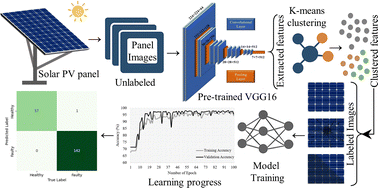
Photovoltaic (PV) systems are susceptible to different types of faults, such as electrical, physical, and environmental issues, which can significantly impact power generation and system reliability. Physical faults, such as cracks, delamination, shading, dirt accumulation, and temperature fluctuations, can reduce module efficiency by altering irradiance levels. To address these challenges, accurate and timely fault detection is essential for ensuring optimal PV system performance and longevity. In this work, we propose a novel machine learning (ML) approach for fault detection using unlabeled electroluminescence (EL) images of PV panels. First, we label the dataset through k-means clustering, applied to features extracted using transfer learning (TL) from a pre-trained VGG-16 model's convolutional and pooling layers. k-Means clustering categorizes the images into three classes based on Silhouette scores, with all healthy panels grouped together. We employ Principal component analysis (PCA) to reduce dimensionality, revealing that 64 principal components account for 95% of the variance in the data. Finally, we train and evaluate classical ML models, including random forest (RF) for binary classification and logistic regression (LR) for three-class classification, achieving accuracies of 97.54% and 89.44%, respectively. We empirically demonstrate that data augmentation further improves the performance of the three-class classification, with RF emerging as the best classifier at 91.5% accuracy. Additionally, we note that the convolutional neural network (CNN) model, which is comparatively lightweight and computationally efficient, saw an increase in accuracy from 98% to 99.5% with data augmentation for binary classification, while the semi-supervised learning approach for the three-class problem achieved an average accuracy of 92.25%. By combining TL, k-means clustering, and data augmentation, our proposed approach enhances fault detection accuracy, reduces reliance on manual labeling, and improves PV system reliability. The proposed method advances automated fault detection techniques and supports the broader adoption of renewable energy systems.
- This article is part of the themed collection: Research advancing UN SDG 7: Affordable and clean energy
 Please wait while we load your content...


