


 PLATFORM UPDATE:


Machine learning-assisted optimization of Cu-based HTLs for lead-free Sr3PBr3 perovskite solar cells achieving over 30% efficiency via SCAPS-1D simulation

Abstract
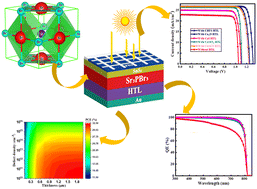
The pursuit of efficient and stable lead-free perovskite solar cells (PSCs) is critical for sustainable photovoltaic technologies. In this work, we systematically investigated Sr3PBr3-based PSCs incorporating five different copper-based hole transport layers (HTLs)—Cu2O, CuI, CuSbS2, CuSCN, and Cu2BaSnS4 (CBTS)—using SCAPS-1D simulations. The device configuration FTO/SnS2/Sr3PBr3/HTL/Au was optimized to evaluate the impact of HTL selection, absorber thickness, doping concentration, defect density, series resistance, and temperature on photovoltaic performance. The results demonstrate that the HTL choice strongly governs charge extraction, interfacial recombination, and stability. Among the candidates, CBTS exhibited the highest efficiency, achieving a power conversion efficiency (PCE) of 30.78% with an open-circuit voltage (VOC) of 1.32 V, a short-circuit current density (JSC) of 26.82 mA cm−2, and a fill factor (FF) of 87.05%. Machine learning (ML) models trained on simulation datasets provided predictive accuracies above 99.6% and, through SHAP (SHapley Additive exPlanations) analysis, revealed that acceptor density and defect density are the most influential parameters controlling device performance. This combined simulation–ML framework establishes CBTS as a highly promising non-toxic HTL and provides actionable insights for the design of stable, high-efficiency lead-free PSCs.
- This article is part of the themed collection: Energy Advances Recent HOT Articles
 Please wait while we load your content...


