


 PLATFORM UPDATE:


Upcycling of PET-based plastic bottles into carbon dots for photocatalytic degradation of Reactive Black 5 using response surface methodology
 *d
*d
Abstract
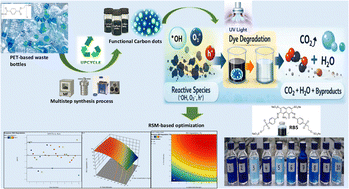
Water contamination and plastic pollution are the most prominent environmental issues, demanding state-of-the-art, sustainable remediation strategies. This study describes the upcycling of waste polyethylene terephthalate (PET) bottles into carbon dots (CDs) and their application for the degradation of Reactive Black 5 (RB5) dye in water. CDs derived from PET were successfully synthesized through a multistep green approach. The synthesized CDs were characterized for their structural, optical and surface features. UV-Vis revealed typical CD absorption behavior with an optical band gap of 3.14 eV. pH-dependent fluorescence spectra confirmed the presence of surface-state emission. FTIR, XRD, DLS, and AFM results were consistent with the presence of surface functionalities and defects, surface-domains of disordered carbon materials, nanoparticle dispersion and CD-like morphology. Box–Behnken-based Response Surface Methodology (RSM) models were established and optimum conditions were found by studying the effects of important operational parameters on RB5 degradation. The synthesized CDs exhibit a high removal rate of RB5 under light illumination (79.6–91.2%), whereas dark removal was relatively low (10.7–18.4%), which indicates that the major contribution came through light-driven processes, with the net photocatalytic degradation being high (68.9–72.8%). The RSM study established a region of optimal operation (pH = 7.4, CD dose = 0.50 g L−1, time = 75 minutes, and RB5 = 26 mg L−1). The experimental response was very similar to the predicted one, and this confirms the accuracy of the statistical optimization. PET-derived CDs offer an inexpensive, green, and efficient medium for dye-contaminated wastewater purification.
 Please wait while we load your content...


