


 PLATFORM UPDATE:


Insights into complementary exposomic targeted analysis and suspect screening approaches: a case study examining human serum for chemicals with LC-IMS-MS
 *a
Nikki
Barlow,
b
Kara M.
Joseph,
a
Sarah J.
Rehm,
a
Weihsueh A.
Chiu,
b
Gang
Han,
c
Yu-Syuan
Luo,
d
Ivan
Rusyn
b
and
Erin S.
Baker
*a
*a
Nikki
Barlow,
b
Kara M.
Joseph,
a
Sarah J.
Rehm,
a
Weihsueh A.
Chiu,
b
Gang
Han,
c
Yu-Syuan
Luo,
d
Ivan
Rusyn
b
and
Erin S.
Baker
*a
Abstract
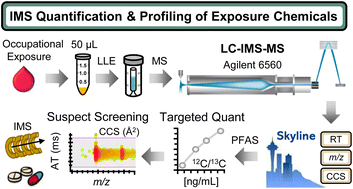
Although PFAS exposure is widespread in the general population, concern is heightened for individuals with unique occupational exposure scenarios. Accordingly, the PROject for Military Exposures and Toxin History Evaluation in US service members (PROMETHEUS) study is evaluating whether serum chemical exposure profiles correlate with cancer incidence in large cohorts (typically hundreds of samples per analysis) among military service members who may experience distinct occupational and environmental exposures. Here we describe analytical workflow development and results from a pilot subset (n = 36) of human serum samples using an integrated targeted and suspect-screening LC-IMS-MS platform. Serum (50 µL) was extracted by acid-assisted protein precipitation with isotopically labeled internal standards, concentrated, and analyzed by LC coupled to an Agilent 6560 IM-QTOF. Targeted PFAS quantitation was performed using matrix-matched calibration curves and was benchmarked against NIST SRM 1957 to assess method accuracy. Across the samples, the targeted panel captured predominantly legacy PFAS as anticipated noting their prevalence in prior studies (e.g., PFOS, PFOA, 8 : 2 FTS, N-MeFOSAA, etc.). Ultra-short-chain PFAS presented class-specific analytical challenges; trifluoromethanesulfonic acid (TFMS) was observed, whereas trifluoroacetic acid (TFA) eluted near the void volume and exhibited pronounced clustering in the ion mobility dimension, precluding reliable quantitation. In parallel, CCS-based mobility filtering supported suspect screening against an exposomic library (∼1100 entries) to expand detectable chemical space beyond targeted PFAS. Suspect screening yielded 49 non-PFAS candidates meeting accurate mass and CCS agreement criteria, and correlation analysis recapitulated expected co-exposure groupings among legacy PFCAs/PFSAs and structurally related suspect analytes. Collectively, these results establish a scalable, CCS-informed LC-IM-MS workflow for integrated targeted PFAS quantitation and exposomic suspect screening, enabling higher-powered association testing in the full set of PROMETHEUS samples and other large-scale human biomonitoring studies.
- This article is part of the themed collection: HOT articles from Environmental Science: Advances
 Please wait while we load your content...


