


 PLATFORM UPDATE:


A novel approach to long-term source contribution of ambient PM2.5 from residential solid fuel burning using the FUSTA methodology

Abstract
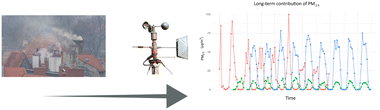
Managing ambient fine particulate matter (PM2.5) requires determining how much different PM2.5 sources contribute over time. This study uses FUSTA (Fuzzy SpatioTemporal Apportionment) to estimate how much residential solid fuel burning (RSFB) contributes to long-term PM2.5 concentrations. FUSTA has been applied to multiyear data for two cities in Chile and one in Poland, at which ongoing impacts of RSFB on ambient PM2.5 are reported. These results were validated by comparison with short-term receptor model (RM) estimates for the three cities, leading to Pearson correlations r = 0.84, 0.97, and 0.89, and linear slopes within 10% of unity, showing methodological consistency. The spatiotemporal pattern (STP) associated with RSFB is qualitatively similar in the three cities, with high seasonality, peak values in winter, contributions that come from all wind directions, and a diurnal cycle with peak values around midnight. The novelty of the proposed methodology is the estimation of long-term contributions of RSFB to ambient PM2.5 for the three cities, without relying on emission inventories nor long-term RM results. The trends observed in the long-term contribution of RSFB to PM2.5 concentration were significant but small on an annual basis, suggesting that current RSFB regulations should be reconsidered.
 Please wait while we load your content...


