


 PLATFORM UPDATE:


Examining the impact of small-amplitude hydraulic transients on biofilm development and adhesion in a full-scale, controlled water distribution environment
 *a
Artur
Sass Braga,
b
Benjamin
Anderson,
b
Cristovão Vicente Scapulatempo
Fernandes
c
*a
Artur
Sass Braga,
b
Benjamin
Anderson,
b
Cristovão Vicente Scapulatempo
Fernandes
c
Abstract
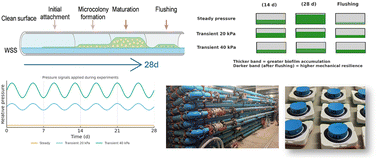
Biofilms play a crucial role in drinking water distribution systems (DWDS), as they influence microbial stability and water quality. While the effects of steady-state hydraulic conditions on biofilm formation and adhesion are well documented, the influence of small-amplitude hydraulic transients remains unexplored. This study examines the impact of small-amplitude transients on biofilm development and adhesion to the pipe wall, mobilization behavior during flushing, and microbial activity in the bulk water in a full-scale PVC distribution pipe laboratory. Over a 28 days biofilm conditioning period, biofilms were subjected to steady-state flow and periodic transient events, followed by controlled flushing to evaluate the detachment behavior. The key findings showed that a moderate transient pulse (20 kPa) enhanced biofilm adhesion to the wall and led to a more uniform biofilm distribution along the pipe wall. A stronger transient pulse (40 kPa) inhibited biofilm accumulation and promoted continuous detachment from the wall during the 28-days biofilm conditioning period. Pipe flushing confirmed that biofilms formed under moderate and strong transient conditions exhibited greater wall adhesion and resistance to mobiliation during flushing as compared to those grown under steady-state flow conditions. These findings suggest that controlled hydraulic transients may play a role in biofilm management strategies, offering the potential to optimize DWDS maintenance and reduce microbial mobilization risks. However, further research is needed to assess the long-term effects in real-world systems with diverse pipe materials, nutrient conditions, and disinfection regimes.
 Please wait while we load your content...


