


 PLATFORM UPDATE:


Information-based approach to PM2.5 estimation and air quality assessment using statistical and deep learning models
 *g
*g
Abstract
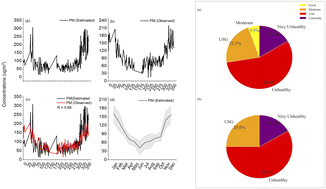
In Pakistan, Peshawar City is persistently experiencing high concentrations of fine particulate matter (PM2.5), frequently surpassing national as well as international air quality standards. For this purpose, the present study aims to enhance the accuracy of PM2.5 estimation at the city scale through a data-driven and interdisciplinary modeling framework. To achieve this, a series of predictors, such as air pollutants (nitrogen dioxide (NO2) and sulphur dioxide (SO2)), meteorological conditions (temperature, wind speed, humidity), and satellite-based aerosol optical depth (AOD), were used to construct a multiple linear regression (MLR) model. Similarly, the Long Short-Term Memory (LSTM) and Convolutional Neural Network (CNN) were modeled to estimate PM2.5 using historical ground-level PM2.5 data in the year 2021, leveraging their capabilities to model temporal trends. The results revealed that estimated PM2.5 levels using the CNN model were almost in the same range as the available measured concentrations, whereas MLR and LSTM models showed some variations against measured values. The insights about their comparative analysis showed that the CNN model could achieve better estimation than MLR and LSTM models. The CNN model achieved a root mean square error (RMSE) of 34.89 µg m−3 and coefficient of determination (R2) of 0.79, indicating higher estimation accuracy. Both the LSTM (R2 = 0.74 and RMSE = 51.93 µg m−3) and MLR (R2 = 0.46 and RMSE = 44.35 µg m−3) models underperformed. Based on the air quality index (AQI), the study region has experienced extremely unhealthy and healthy conditions, which may lead to the formation of visible haze and ultimately to the particulate component of smog. Generally, this study highlights the superior performance of deep learning approaches for urban air quality assessment. In conclusion, this study breaks new ground by applying and integrating MLR, CNN, and LSTM models in the study region. It will help in opening a promising direction for city-specific air quality modeling in any regional or local urban environment.
 Please wait while we load your content...


