


 PLATFORM UPDATE:


Chemical signatures and disinfection by-product formation potential in bottled water from Bahrain's market
 *ab
Abd El-Galil E.
Amr,
c
Ahmed M.
Naglah,
*c
Hazem A.
Ghabbour,
de
Hamad M.
Alkahtani,
f
Mohamed A.
Al-Omar
f
and
Abdulrahman A.
Almehizia
c
*ab
Abd El-Galil E.
Amr,
c
Ahmed M.
Naglah,
*c
Hazem A.
Ghabbour,
de
Hamad M.
Alkahtani,
f
Mohamed A.
Al-Omar
f
and
Abdulrahman A.
Almehizia
c
Abstract
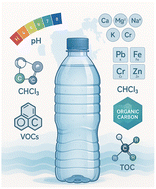
This study investigates the chemical composition, trace contaminant profile, and disinfection by-product (DBP) formation potential of sixteen bottled water brands commercially available in the Kingdom of Bahrain. While bottled water consumption in arid, desalination-dependent nations has grown rapidly, little is known about its comprehensive chemical characteristics or public health implications. Here, both locally produced (desalination-based) and imported natural mineral waters were analyzed for major ions, trace metals, total organic carbon (TOC), and trihalomethanes (THMs) using ICP-OES, ion chromatography, and GC-MS. Multivariate statistical tools, including Pearson correlation and principal component analysis (PCA), were applied to elucidate compositional patterns and identify potential DBP precursors. The results revealed that all brands complied with WHO and GCC drinking-water standards; however, distinct chemical fingerprints differentiated imported mineral waters (high Ca2+, Mg2+, TOC) from locally purified waters (low TDS, Na+–Cl− dominance). TOC correlated positively with THM levels (r ≈ 0.68), suggesting that organic carbon in mineral waters may act as a precursor for halogenated DBPs under oxidative processing. Trace metals, including Pb, Ni, and Fe, were detected at concentrations far below health thresholds, indicating effective treatment and packaging integrity. This work provides the first integrated evaluation of bottled water in a hyper-arid, desalination-dependent environment and highlights the need for region-specific monitoring strategies addressing TOC-driven DBP formation. The findings support improved regulatory frameworks for bottled water safety in Gulf Cooperation Council (GCC) countries and contribute to understanding chemical risks in arid-zone drinking water systems.
 Please wait while we load your content...


