


 PLATFORM UPDATE:


A non-contact in situ approach for detecting fluorescent microplastic particles in flowing water using fluorescence spectroscopy

Abstract
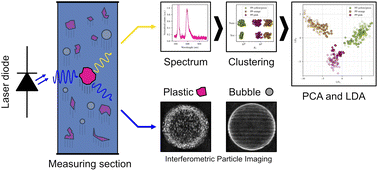
Microplastic (MP) pollution poses increasing risks to aquatic ecosystems and, through the food chain, also to humans. Current detection methods rely on elaborate laboratory procedures such as Raman or FTIR spectroscopy, which involve extensive sample preparation, complex and costly instrumentation, and long analysis times, limiting their suitability for in situ monitoring. Reliable environmental assessment, however, requires continuous detection of MPs directly in flowing water. This study investigates the feasibility of combining fluorescence spectroscopy and interferometric particle imaging (IPI), the latter relying on particle scattering of coherent light and the detection of interference patterns, for detecting and characterising individual fluorescent MP particles under flow conditions. Each technique was initially evaluated separately to establish its feasibility. Polypropylene (PP) particles with and without incorporated fluorescent dyes were prepared, suspended in a flow-through cuvette, and illuminated by a laser diode at 445 nm. Fluorescence spectra and defocused particle images were recorded. Spectral analysis focused on emission maxima, full width at half maximum, and intensity ratios, while IPI provided information on particle type and size. Fluorescence spectroscopy enabled a clear separation between two main particle classes (yellow/green vs. orange/pink) based on spectral peak positions. Additional differentiation was achievable through intensity ratios and numerical clustering (PCA and subsequent LDA). Pure PP served as a negative control, confirming that fluorescence originates from dyes rather than the polymer matrix. However, absolute fluorescence intensities proved unreliable due to variations in particle size, dye type, and orientation. IPI images enabled the differentiation of air bubbles from PP particles and indicated the potential for particle sizing. Together, these findings demonstrate the feasibility of both fluorescence-based classification and IPI analysis under flow conditions, outlining a pathway towards simpler and more robust in situ monitoring of MPs in aquatic environments.
 Please wait while we load your content...


