


 PLATFORM UPDATE:


Oxidation of TcO2 and UO2 by aqueous Mn(iii)-citrate and Mn(iii)-tartrate under anoxic conditions: implications for technetium and uranium fate and transport

Abstract
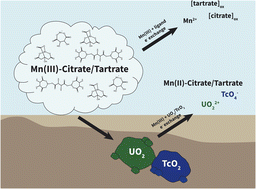
There are several United States Department of Energy (DOE) sites that have been dealing with the problem of legacy nuclear waste in the environment for many generations. Two major risk-driving radionuclides in this legacy waste are uranium and technetium-99. Due to their radioactivity, the increase in concentration of these radionuclides in the environment represents a significant concern to environmental health and safety. Uranium and technetium both have increased solubility and mobility in the environment when oxidized from U(IV) to U(VI) and from Tc(IV) to Tc(VII), respectively. This project investigated the role of Mn(III)-tartrate and Mn(III)-citrate in influencing the redox behavior and stability of uranium, from uranium dioxide (UO2), and technetium, from technetium oxide (TcO2). For each radionuclide, anaerobic batch kinetic experiments of UO2 and TcO2 in the presence of these Mn(III)-ligands were conducted at pH 8 and 10, and the radionuclide concentration in the aqueous phase was monitored over time. Both the Mn(III)-tartrate and Mn(III)-citrate complexes effectively induced dissolution of uranium and technetium, however, differences were seen with increasing ligand concentration and pH. Higher concentrations of the Mn(III)-ligand complexes resulted in higher concentrations of aqueous uranium or technetium over time, supporting Mn(III) induced oxidation of these radionuclides. Additionally, the Mn(III)-tartrate complex resulted in more oxidation at pH 8 for both uranium and technetium while the Mn(III)-citrate ligand provided more oxidation at pH 10 for uranium and was comparable for technetium. The data presented in this study is useful for creating expected uranium and technetium transport models based on the abundance of naturally occurring manganese species.
 Please wait while we load your content...


