


 PLATFORM UPDATE:


Occupational health risks from welding emissions: exposure and deposition of PM10, PM2.5, and ultrafine particles across welding methods
 *abc
and
Sarath K.
Guttikunda
d
*abc
and
Sarath K.
Guttikunda
d
Abstract
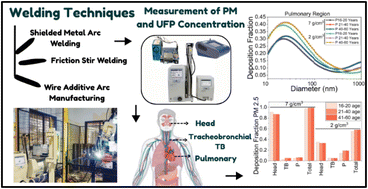
Welding emits high levels of particulate matter (PM) and ultrafine particles (UFPs), which are associated with health risks including asthma, chronic obstructive pulmonary disease (COPD), and certain cancers. This study quantifies inhalation doses and health risks from different PM size fractions (PM10, PM2.5, and UFPs: 15–595 nm) generated by Shielded Metal Arc Welding (SMAW), Wire Arc Additive Manufacturing (WAAM), and Friction Stir Welding (FSW) under typical industrial conditions. Real-time PM and UFP concentrations were measured using a scanning-mobility-particle-sizer and low-cost PM sensors. Inhalation doses were estimated based on age, height, breathing frequency, inhalation rate, activity levels, and density variation (2 to 7 g cm−3), with age-specific respiratory deposition (16–20, 21–40, 41–60 years) quantified via the multiple-path-particle-dosimetry model for total, regional, and lobar levels. For PM10, the highest deposition fraction (80–95%) occurred in the head region of individuals aged 16–20, while PM2.5 showed the highest deposition fraction in the 41–60 age group, particularly in the head (35–90%) and pulmonary (19%) regions. UFPs (<100 nm) are predominantly deposited in the thoracic and pulmonary regions, and the magnitude of UFP deposition in these regions increases with higher welding currents and voltages. SMAW and WAAM processes exhibited the highest particle deposition, with deposition of both PM and UFPs being greatest in the oldest age group. Within the lungs, the lower lobes showed the greatest particle deposition (21%), dominated by UFPs across all age groups. The estimated excess lifetime cancer risk (1.28 × 10⁻⁴ to 6.88 × 10⁻⁴) exceeded WHO benchmark thresholds, while hazard quotients for PM2.5 (20–88) and PM10 (16–81) were significantly above recommended safety limits. These findings underscore the urgent need to regulate occupational exposure and include UFPs in air quality standards.
 Please wait while we load your content...


