


 PLATFORM UPDATE:


Utilizing PMF and Monte Carlo-based models to evaluate toxic metal enrichment pathways, sources, and public health risks in an unplanned urbanized dumpsite soil
 ab
Sajal Kumar
Adhikary,
a
Abu Reza Md. Towfiqul
Islam
h
and
Md. Abu Bakar
Siddique
*c
ab
Sajal Kumar
Adhikary,
a
Abu Reza Md. Towfiqul
Islam
h
and
Md. Abu Bakar
Siddique
*c
Abstract
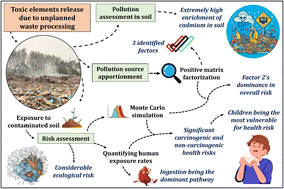
Improper waste management in municipal dumpsites raises health concerns due to toxic elements (TEs). This study evaluates the enrichment, sources, and public health risks of TE contamination in an urban dumpsite in a southeastern city of Bangladesh. Nine TEs were determined spectrophotometrically from 175 representative soil samples of 35 sites. Pollution indices, the Positive Matrix Factorization (PMF) model, and Monte-Carlo Simulation (MCS) were employed in assessing contamination levels, apportion sources, and associated public health risks. The results revealed significant topsoil contamination, with Cd contributing 91% to the overall ecological risk. Three distinct sources contributing to TE contamination were identified: industrial sources (F1, 15.78%, dominated by Cd), geogenic origins (F2, 40.93%, characterized by Fe, Co, Mn, and Ni), and mixed residential/commercial/traffic sources (F3, 43.30%, with high loadings of Cu, Zn, Pb, and Cr). Health risk assessment (HRA) revealed that children faced 4.61 times higher non-carcinogenic risk (NCR) and 2.53 times higher carcinogenic risk (CR) compared to adults. NCRs were primarily driven by Fe and Mn, while Ni, Cd, and Cr were the main contributors to CRs, exceeding acceptable limits. Using the PMF-HRA method, F2 was identified as a significant source of both NCR (79.27% in children and 88.69% in adults) and CR (66.18% in children and 61.63% in adults), with F3 also posing significant risks, particularly for children. These results highlight the urgent need for comprehensive waste management reforms and targeted remediation strategies at the studied dumpsite to mitigate TE contamination, safeguard public health, and protect the surrounding environment, particularly for vulnerable populations and critical infrastructure in the region.
 Please wait while we load your content...


