


 PLATFORM UPDATE:


Health risk assessment of polycyclic aromatic hydrocarbons in indoor dust from Okerenkoko community, Warri, Nigeria

Abstract
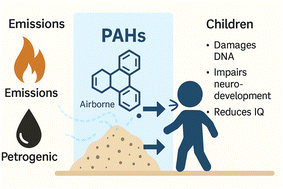
This study investigated the occurrence, sources, and health risks of polycyclic aromatic hydrocarbons (PAHs) in indoor dust from the Okerenkoko Community, Warri, Nigeria. Dust samples were collected from three locations: NMU Campus/Lodge (NMU CL), Zion Residential Area (ZA), and Okerenkoko II Area (Okk). Total PAH concentrations (∑PAHs) ranged from 0.0546 to 0.1005 mg kg−1, with higher levels at ZA and Okk, reflecting spatial variability influenced by local anthropogenic activities, including artisanal crude oil refining, biomass burning, combustion-related emissions from marine transport, and domestic fuel use. Compositional analysis revealed a predominance of 3- to 5-ring PAHs, with low- and high-molecular-weight (LMW and HMW) species contributing almost equally (50.8% and 49.2%, respectively), suggesting mixed pyrogenic–petrogenic sources. Diagnostic ratios (e.g., Ant/(Ant + Phe), Flt/(Flt + Pyr), BaA/(BaA + Chr), IP/(IP + BghiP)) indicated that NMU CL and ZA were mainly influenced by pyrogenic sources, whereas Okk reflected both pyrogenic and petroleum-related inputs. Principal component analysis (PCA) confirmed distinct contributions, with HMW PAHs associated with combustion processes and LMW PAHs linked to volatilization or indoor emissions. Health risk assessment showed that adults exhibited the highest incremental lifetime cancer risks (ILCRs), followed by children and adolescents, with total ILCRs ranging from 1.05 × 10⁻⁷ to 1.90 × 10⁻⁷ across all sites. Dermal contact and ingestion were identified as the dominant pathways, while inhalation contributed negligibly (≤10−12). For example, adults at Okk recorded the highest ILCR (1.90 × 10⁻⁷), driven largely by dermal exposure, whereas children's ILCRs ranged between 1.26 × 10⁻⁷ and 1.75 × 10⁻⁷. Non-cancer risk evaluation indicated hazard indices (HI) for all age groups remained far below 1 (children: 3.61 × 10⁻⁵ to 4.88 × 10⁻⁵), suggesting negligible non-carcinogenic risk. These findings reveal the complex nature of PAH sources in indoor dust and highlight the importance of dermal exposure alongside ingestion, particularly for adults. The results underscore the heightened exposure risks for vulnerable groups and the urgency of targeted environmental controls and community health interventions in the Niger Delta.
 Please wait while we load your content...


