


 PLATFORM UPDATE:


High-performance Dy2Ti2O7 pyrochlore ceramics for dielectric energy storage: sintering temperature studies
 a
Chunchang
Wang
*a
a
Chunchang
Wang
*a
Abstract
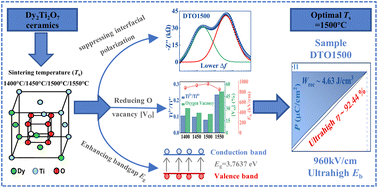
Pyrochlore-type Dy2Ti2O7 (DTO) ceramics were fabricated via a solid-state reaction method. The influence of sintering temperature on their microstructure and energy storage performance (ESP) was systematically investigated. The optimal sintering temperature was identified as 1500 °C, under which the DTO ceramic exhibited a dense and uniform microstructure, a wide bandgap, low oxygen vacancy concentration and weak interfacial polarization. These characteristics synergistically enhanced both the breakdown strength (Eb) and polarization difference (ΔP), leading to an excellent recoverable energy density (Wrec) of 4.63 J cm−3 and a high energy-storage efficiency (η) of 92.44%. Additionally, the optimized ceramic demonstrated outstanding stability, with a relative variation of efficiency Δη/η ≤ 3.1% over 20–140 °C and a relative variation of recoverable energy density ΔWrec/Wrec ≤ 2.6% over 10–200 Hz at room temperature. This work demonstrates that pyrochlore-type ceramics are promising candidates for high-performance lead-free energy-storage applications, and sintering engineering can effectively optimize their energy-storage properties.
- This article is part of the themed collection: Journal of Materials Chemistry C HOT Papers
 Please wait while we load your content...


