


 PLATFORM UPDATE:


Topological superconductivity in two-dimensional ScSiX (X = Cl, Br) monolayers
 *a
Jingjing
Wang,
a
*a
Jingjing
Wang,
a
Abstract
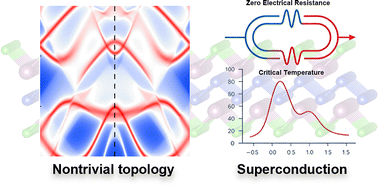
Two-dimensional (2D) materials that host both Dirac points and van Hove singularities (VHSs) provide a fertile platform for exploring exotic quantum states, including high-temperature ferromagnetism and topological superconductivity. However, material candidates simultaneously exhibiting non-trivial electronic topology and intrinsic superconductivity remain rare. Here, we predict two rectangular 2D monolayers, ScSiCl and ScSiBr, with exceptional stabilities using first-principles calculations. Both monolayers exhibit VHSs located near the Dirac points in the vicinity of the Fermi level. Based on Bardeen–Cooper–Schrieffer (BCS) theory, we demonstrate that ScSiCl and ScSiBr are intrinsic phonon-mediated superconductors with transition temperatures (Tc) of 1.412 and 0.578 K, respectively. Remarkably, the inclusion of spin–orbit coupling (SOC) opens a continuous band gap at the Dirac points, yielding a Z2 topological invariant of Z2 = 1 and giving rise to robust helical edge states. The coexistence of topological order and intrinsic superconductivity suggests the “self-proximity” effect in the 2D monolayer, potentially hosting 1D topological superconducting edge states. Our findings indicate that ScSiCl and ScSiBr are versatile 2D platforms for exploring the interplay between topological phases and superconductivity, with promising implications for the development of next-generation quantum devices.
- This article is part of the themed collection: Journal of Materials Chemistry C HOT Papers
 Please wait while we load your content...


