


 PLATFORM UPDATE:


The emergence of quantum dot complexes

Abstract
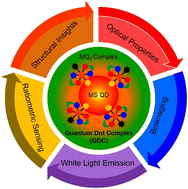
While the dimension-dependent properties of quantum dots (Qdots) – in addition to the dependence on the constituents and structure of the core – have received great attention, the importance of their surface for the physical and chemical properties of the novel form of matter has also been recognized. For example, surface defects alter the physical properties and chemical reactivity of the Qdots and have largely been addressed by passivation, which includes bonding molecules to the surface. On the other hand, the organic molecules forming inorganic complexes in such processes also lead to the generation of novel properties that are specific to such surfaces. Thus, the formation of quantum-dot complexes (QDCs) leads to synergistic properties that are typically beyond the limits of the components as such. For example, optical properties such as the photoluminescence emission frequencies, quantum yields and lifetimes of both the Qdot and the surface complex are typically different from those of the components and importantly, such properties could also be chemically tuned based on the nature of complexation on the surface. This combination broadens their application potential in white light generation, high-resolution and probe-sensitive bioimaging, and molecular sensing. The challenges in synthesis, especially scalability, compatibility with device architectures, and promise of versatile application potential make the QDCs an attractive frontier of research in chemistry, biology and materials science.
- This article is part of the themed collection: Journal of Materials Chemistry C Recent Review Articles
 Please wait while we load your content...


