


 PLATFORM UPDATE:


Deconvoluting the electronic landscape of ZnO using 2D excitation–emission spectroscopy: effects of microstructuring, doping and restructuring

Abstract
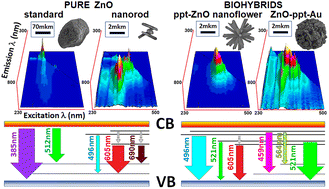
Understanding the electronic properties and energy relaxation pathways of semiconductors, is essential for developing next-generation materials for applications in areas as diverse as medicine, flat panel-displays and sensing. In this contribution we apply two-dimensional excitation–emission spectroscopy to interpret energy relaxation pathways in pure and biohybrid zinc oxide (ZnO) micro- and nanostructures of differing morphologies and evaluate the effects of chemical processing and plasmonic doping. In pure ZnO microcrystals with low surface-to-volume ratio, ultraviolet near-band-edge exciton emission dominates relaxation. In contrast, ZnO nanorods, with high surface-to-volume ratio exhibit strong red and near-infrared emission we ascribe to zinc interstitials, oxygen vacancies, and oxygen interstitial defects. Hybrid ZnO structures display a redistribution of energy flow to yield a distinctly different set of red and green emissions stimulated from lower energy states we assign to extended zinc interstitials, oxygen vacancies, and zinc vacancies. Post-synthetic modification preferentially attenuates lower-energy donor states, thereby enhancing higher-energy emission channels. For treatment with polyvinyl alcohol we discuss the role of hydroxyl groups in the restructuring of surface interstitial defects and passivation of negative zinc vacancies, while borohydride treatment can stimulate reduction-driven compensation of positively charged defects and hydrogen ion diffusion. Application of two-dimensional spectral analysis is critically important to avoid ambiguity in evaluation of electronic properties of semiconductors such as zinc oxide and materials with complex networks of energy relaxation pathways.
 Please wait while we load your content...


