


 PLATFORM UPDATE:


Carbazole-based host materials for red to near-infrared OLEDs: molecular design strategies and structure–property relationships

Abstract
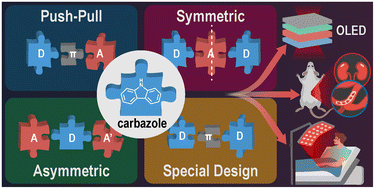
Achieving high efficiency and long-term stability in red-to-near-infrared (NIR) organic light-emitting diodes (OLEDs) remains challenging due to narrow bandgaps, severe exciton quenching, and charge imbalance. Designing a suitable host is essential to overcome these limitations, as the host dictates exciton confinement, charge transport, and energy transfer to the emitter. Among various candidates, carbazole derivatives stand out as promising scaffolds owing to their excellent hole-transporting properties, tunable optoelectronic characteristics, low oxidation potential, and structural versatility. This review categorizes carbazole-based hosts into four main architectural designs: push–pull, symmetric, asymmetric, and special frameworks. We examine reported carbazole-based hosts used for red-emitters with emissive peaks above 600 nm and analyze the relationship between molecular architecture and device performance. Furthermore, we highlight how each architectural design influences charge balance, exciton confinement, and host–guest interaction in red-to-NIR OLEDs. By mapping the demonstrated carbazole-based hosts into a unified architectural framework, this review establishes structure–function principles and outlines future directions for the development of carbazole-based hosts tailored for high-performance red-to-NIR OLEDs.
- This article is part of the themed collection: Journal of Materials Chemistry C Recent Review Articles
 Please wait while we load your content...


