


 PLATFORM UPDATE:


Recent research development in two-dimensional transition metal dichalcogenides for dopamine sensing

Abstract
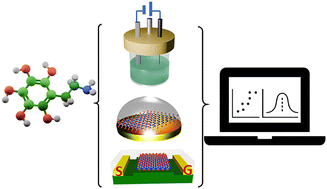
Mental health problems are closely linked to imbalances in neurotransmitters, with dopamine serving as a critical biomarker for early diagnosis of mental health disorders. Conventional detection methods are often limited by complex instrumentation, poor selectivity, and a lack of real-time capability. Wearable sensors have emerged as a promising solution, offering real-time, non-invasive monitoring of dopamine and other neurotransmitters, which play key roles in the regulation of mental health. The performance of these sensors is highly influenced by the properties of the active materials used in their fabrication. Among emerging materials, two-dimensional transition metal dichalcogenides (2D TMDs) have garnered significant attention due to their distinctive physicochemical properties, including high surface area, tunable electronic structure, and excellent electrocatalytic activity. In this review, we discuss recent developments in 2D TMD-based dopamine detection, covering synthesis approaches, structure–property relationships, and their implementation in electrochemical, optical, and field-effect transistor sensors. We especially emphasize performance benchmarking against conventional materials, highlighting the advances in sensitivity, selectivity, and miniaturization of 2D TMDs-based sensors for dopamine detection. We also discuss the current challenges while outlining future directions in this research domain. By integrating materials science with biomedical needs, this review highlights the potential of 2D TMDs to enable next-generation neurochemical monitoring technologies.
- This article is part of the themed collections: Journal of Materials Chemistry C Recent Review Articles and Journal of Materials Chemistry C HOT Papers
 Please wait while we load your content...


