


 PLATFORM UPDATE:

Trap-controlled operational stability in dibenzofuran-based hosts for blue TADF-OLEDs

Abstract
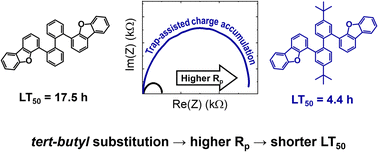
Stability remains the principal bottleneck for blue TADF-OLEDs, and it is strongly affected by the host response to electrical stress. Here we report a structure–property study of four high-triplet-energy dibenzofuran–biphenyl (DBF–BPh) hosts for stable blue TADF devices. DBF linkage position (2 vs. 4) and tert-butyl substitution are exploited to tune solid-state charge dynamics within a chemically robust scaffold. All hosts exhibit high neat-film triplet energies (T1 = 2.77–2.87 eV) suitable for blue/sky-blue exciton confinement, together with elevated multi-state bond dissociation energies (BDEs) that exceed the fragility range typical of anionic C–N linkages in common carbazole-type hosts. In doped blue TADF-OLEDs, the 4-linked DBF–BPh hosts deliver the best overall device performance, reaching EQEmax = 23.5% with low efficiency roll-off and device lifetime LT50 = 17.5 h at 1000 cd m−2 (275 h at 100 cd m−2). In contrast, tert-butyl-substituted hosts exhibit 2–4× shorter LT50, despite comparable energetics and BDE profiles. Bias-dependent impedance spectroscopy combined with equivalent-circuit analysis indicates a larger resistive relaxation component in the tert-butyl hosts, consistent with increased trap-limited conduction and carrier accumulation, which accelerate exciton–polaron loss under operation. These results implicate trapping as a major contributor to device degradation in this DBF host series, thereby establishing trap suppression as a practical target for improving the lifetime of blue TADF-OLEDs.
 Please wait while we load your content...


