


 PLATFORM UPDATE:


Freeze-drying enabled porous layered δ-MnO2/rGO composites from MnO2 polymorphs for high-performance AZIBs
 *a
*a
Abstract
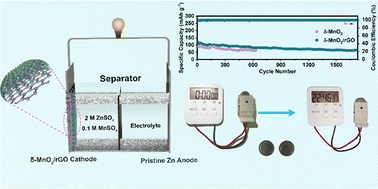
Compared with α-, β- and γ-MnO2, δ-MnO2 possesses a large interlayer spacing, abundant active sites and high compatibility with aqueous electrolytes. Due to these advantages, δ-MnO2 is considered a potential candidate for efficient aqueous zinc-ion battery and high-safety energy storage systems. Nevertheless, its structural instability and suboptimal electrical conductivity hinder it from being an ideal electrode material. In this study, a 3D conductive framework was fabricated by uniformly integrating δ-MnO2 and ultrathin rGO nanosheets through a simple freeze-drying process. The introduction of rGO endows the δ-MnO2/rGO composites with a unique “conductive network–dispersion support” structure. The as-constructed 3D architecture effectively overcomes the intrinsically low conductivity of δ-MnO2 and decreases the charge transfer resistance. Meanwhile, the porous framework enlarges the electrode–electrolyte contact area, accommodates the volume variation and lattice distortion during Zn2+ insertion/extraction, and thus maintains structural integrity upon long-term cycling. Consequently, the δ-MnO2/rGO electrode exhibits excellent cycling stability, with a maximum specific discharge capacity of 127.6 mAh g−1 at 1 A g−1, which remains at 82.1 mAh g−1 after 600 cycles. The specific capacity is obviously better than that of δ-MnO2 (63.2 mAh g−1 after 450 cycles).
 Please wait while we load your content...


