


 PLATFORM UPDATE:


A theoretical framework for benchmarking amphiphilic 2D covalent organic frameworks for atmospheric water harvesting

Abstract
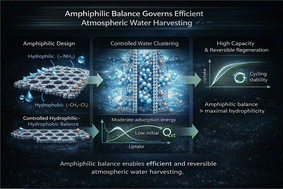
Atmospheric water harvesting (AWH) relies on sorbent materials that combine high water uptake at low relative humidity with low regeneration energy and long-term cycling stability. Covalent organic frameworks (COFs) offer a metal-free and structurally tunable platform for this purpose; however, clear molecular-level design rules for optimizing their water adsorption thermodynamics remain limited. Herein, we present a comprehensive multiscale computational investigation of amphiphilic 2D COFs derived from hydrazine-linked AB-COF, systematically functionalized with hydrophilic and hydrophobic groups. Density functional theory (DFT), grand canonical Monte Carlo (GCMC), and molecular dynamics (MD) simulations were employed to evaluate structural stability, electronic properties, pore characteristics, and water adsorption behavior across temperatures from 5 to 45 °C and relative humidities from 20 to 100%. Among the investigated materials, MN-COF (1 : 1 CH3 : NH2) exhibits an optimal balance between water affinity and reversibility. At 25 °C, MN-COF achieves water uptakes of 0.10 g g−1 at 20% RH, 0.26 g g−1 at 50% RH, and 0.54 g g−1 at 100% RH, representing a 25–30% enhancement over pristine AB-COF across the full humidity range. Adsorption energetics reveal a moderate water adsorption energy of −340 kJ mol−1 and low initial isosteric heats of adsorption (Qst ≈ 5–8 kJ mol−1), significantly lower than strongly hydrophilic analogues while sufficient to trigger cooperative pore filling. Moreover, MN-COF retains ∼94% of its initial water uptake after 20 adsorption–desorption cycles, compared to ∼89% retention for AB-COF under identical conditions. These results demonstrate that amphiphilic functional group balance, rather than maximal hydrophilicity, is key to achieving high working capacity, low regeneration, and cycling durability. MN-COF exemplifies this design principle and emerges as a promising metal-free sorbent for energy-efficient atmospheric water harvesting.
 Please wait while we load your content...


