


 PLATFORM UPDATE:


Enhanced thermoelectric performance of SnTe thin films by magnetron co-sputtering with optimized carrier concentration and microstructure
 *a
and
Ji-cai
Zhang
*ac
*a
and
Ji-cai
Zhang
*ac
Abstract
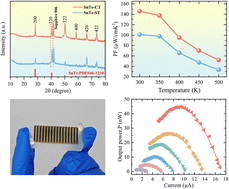
Excessively high hole concentrations, stemming from intrinsic Sn vacancies, constitute a key bottleneck preventing SnTe thermoelectrics from achieving high performance. To overcome this limit, we introduce a Te-target co-sputtering strategy that tailors the defect chemistry and microstructure of SnTe thin films. XRD and SEM analyses reveal that the co-sputtered films possess a refined, more uniform fine-grained architecture. Density functional theory calculations further show that, under Te-rich conditions, Sn vacancies form readily, yet simultaneously generate n-type compensating TeSn antisites that suppress over doping. This compensation mechanism preserves high electrical conductivity while markedly boosting the Seebeck coefficient to 159 µV K−1 at 350 K. Consequently, the power factor averages 141 µW cm−1 K−2 between 300 and 350 K, 41% higher than that of single-target sputtered SnTe. A micro thermoelectric generator fabricated from the co-sputtered film delivers a maximum output of 44.75 nW at a temperature difference of 60 K, substantially outperforming the control device. Our work demonstrates that Te-target co-sputtering offers a synergistic route to optimize both carrier concentration and microstructure, providing an effective pathway for breaking the long-standing performance ceiling of SnTe thermoelectrics.
 Please wait while we load your content...


