


 PLATFORM UPDATE:


Advances in the design of bio-organic resistive switching memory

Abstract
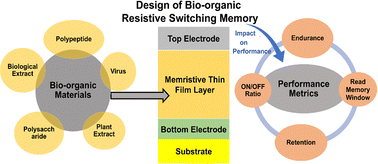
Bio-organic materials have garnered significant attention as sustainable candidates for non-volatile resistive switching memory (RSM) because of their specialized chemical, structural, and environmental advantages. This review presents a design-centered perspective on bio-organic RSM by outlining the key device components required for effective device engineering, including electrode materials, memristive thin films, intermediate layers, substrates, and electrical measurement strategies. Each component is discussed in detail with respect to the material properties and operational parameters that influence overall device performance, such as functional groups, interfacial interactions, and processing conditions. The review further analyses the critical roles of electrode pairing, interfacial chemistry, additive incorporation, and electrical measurement strategies, all of which strongly determine switching behavior, uniformity, and reproducibility. By critically analyzing published results and consolidating design-relevant trends, this review provides a structured framework to guide the rational development of high-performance, reliable, and environmentally sustainable bio-organic RSM technologies.
- This article is part of the themed collection: Journal of Materials Chemistry C Recent Review Articles
 Please wait while we load your content...


