


 PLATFORM UPDATE:


Progress and perspectives on Ti3C2Tx MXene-based composite materials for electromagnetic wave absorption
Abstract
The rapid progress of wireless communication technologies has greatly enhanced information transmission, but has also intensified the complexity of the electromagnetic environment. To address the resulting electromagnetic interference, growing research has focused on high-performance absorbing materials that are lightweight, adaptable, and efficient. Among emerging candidates, two-dimensional transition metal carbides (Ti3C2Tx MXenes) have attracted considerable attention. Ti3C2Tx MXenes possess unique layered structures, excellent electrical conductivity, abundant surface functional groups, and tunable defects, making them highly versatile for applications in energy storage, adsorption, and electromagnetic protection. In electromagnetic wave absorption, these properties enable strong attenuation, yet the inherent high conductivity often leads to poor impedance matching, limiting absorption efficiency. Recent studies have explored strategies such as elemental doping, calcination, magnetic modification, and composite construction to optimize Ti3C2Tx MXene-based nanocomposites. This review summarizes the synthesis methods, structural characteristics, and electromagnetic absorption mechanisms of Ti3C2Tx MXene-based composite materials, and discusses current challenges and future directions for their practical application in defense, medical, and related fields.
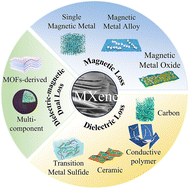
- This article is part of the themed collections: Journal of Materials Chemistry C Recent Review Articles and Journal of Materials Chemistry C HOT Papers
 Please wait while we load your content...


