


 PLATFORM UPDATE:


Metal-driven interface engineering enables multi-functionality in SrTiO3 memristor devices

Abstract
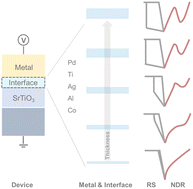
The choice of metal electrode and the possible modifications to the metal/oxide interface morphology critically influence the behavior of the active switching layer in memristive devices. However, this interplay remains largely unexplored and poorly understood. Here, we systematically investigate various commercially popular metal electrodes and correlate their interfacial characteristics with SrTiO3 perovskite logic memristor devices. Using high-angle annular dark-field (HAADF) STEM imaging, we reveal that thicker and chemically active interfacial layers formed by Ag, Al, and Co electrodes enhance oxygen vacancy modulation, leading to pronounced negative differential resistance (NDR) behavior, larger resistive switching windows, and higher Ion/Ioff ratios. Conversely, thinner interfaces formed by Pd and Ti, as well as Cr, Cu, and Ni, exhibit weaker or absent NDR and reduced switching contrast. Atomistic simulations combining density functional theory (DFT) and quantum transport calculations show that metals with low oxide formation enthalpies promote the formation of interfacial oxide layers, enabling oxygen-vacancy redistribution that modulates electron injection into SrTiO3. In contrast, sharp and symmetric interfaces suppress vacancy-driven conductance modulation, consistent with the experimentally observed absence of pronounced switching and NDR. Our findings underscore the pivotal role of interface engineering in enhancing SrTiO3 memristors for multifunctional memory and neuromorphic applications.
 Please wait while we load your content...


