


 PLATFORM UPDATE:


Disorder stabilisation of high pressure Mn2−xCoxScSbO6 double perovskites with complex magnetic properties
 b
and
Y.
Shimakawa
a
b
and
Y.
Shimakawa
a
Abstract
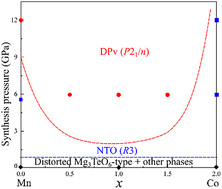
High-pressure synthesis provides a powerful route to stabilise metastable oxides with unconventional structural and magnetic properties. Here we show that Mn2−xCoxScSbO6 (x = 0.5, 1 and 1.5) solid solutions synthesised at 6 GPa pressure form double perovskites (space group P21/n) whereas the previously-reported x = 0 and 2 end members adopt the corundum-derived Ni3TeO6 structure-type (R3) at comparable pressure. This behaviour is consistent with disorder (configurational entropy) assisted stabilisation of the A2BB′O6 double perovskite phase under the reported high-pressure synthesis conditions, and neutron diffraction reveals substantial cation disorder with approximate distribution (Mn2−xSc0.5Cox−0.5)(Sc0.5Co0.5)SbO6 for 0.5 < x < 1.5. The long range antiferromagnetic order previously reported for x = 0 at TN = 22 K is increasingly suppressed by Co-doping. The x = 0.5 sample also orders antiferromagnetically (TN = 18 K) with ordered moments rotated and reduced in magnitude relative to x = 0, but x = 1 and 1.5 exhibit probable spin-freezing transitions (at Tg = 15 and 8 K respectively) without observed long-range magnetic order. This study demonstrates that interesting new magnetic materials may be accessed through a combination of high pressure synthesis and disorder-stabilisation of mixed-cation phases.
- This article is part of the themed collection: Honorary collection in celebration of Prof. D. D. Sarma’s contributions to materials science
 Please wait while we load your content...


