


 PLATFORM UPDATE:


Unlocking high absorption efficiency of Cr3+ ions in magnesium titanates with intrinsically high octahedron distortion

Abstract
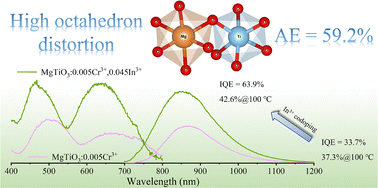
Cr3+ ions are promising near-infrared (NIR) emitters but suffer from low light absorptivity due to parity-forbidden intra-3d transitions. In this work, MgTiO3 (MTO) with highly distorted octahedral units is selected as the host material for Cr3+ doping to generate a broadband NIR emission at ∼870 nm, simultaneously achieving a notable absorption efficiency of nearly 60% at a Cr3+ doping level of only 0.5 mol%. Furthermore, In3+ substitution is introduced to optimize the luminescence performance of MTO:Cr3+, leading to a 2.18-fold enhancement of luminescence and an improvement in thermal stability. Surprisingly, In3+ substitution induces lattice expansion and yet results in an anomalous blue shift of Cr3+ emission to ∼855 nm. A combination of experimental and theoretical approaches demonstrates that the spectral blue shift following In3+ doping can be ascribed to the variations in the site occupation and coupling state of Cr3+ ions. Finally, a NIR phosphor-converted LED (pc-LED) is fabricated using the MTO:Cr3+,In3+ phosphor, with a NIR output power of ∼28.2 mW and a photoelectric conversion efficiency of ∼10.2% at 100 mA driven current. The work offers novel insights into the regulation of light absorption and emission in Cr3+-activated NIR luminescent materials.
 Please wait while we load your content...


