


 PLATFORM UPDATE:


A molecular strategy for Raman enhancement
 *a
*a
Abstract
Raman spectroscopy has been widely utilized for ultrasensitive molecular detection, enabling breakthroughs in biomedical diagnostics, environmental monitoring, and nanotechnology. Amplifying the inherently weak Raman signal is essential for analysis at trace concentrations. Herein, we developed a molecular-level platform that employs discrete molecules as a Raman-enhancement scaffold, amplifying Raman signals through the formation of ion pairs. This method utilizes the donor metal complex [Ni(dmit)2]− (dmit = 2-thioxo-1,3-dithiol-4,5-dithiolate) to sensitively detect target molecules via strong intermolecular charge transfer interactions. Using this complex, target molecules can be detected with high sensitivity at concentrations as low as 1 × 10⁻⁸ M. These findings shed light on the mechanism by which intermolecular charge transfer enhances Raman signals at the molecular level. Furthermore, this molecule-based strategy remains effective in an air-dried phosphate-buffered saline (PBS) environment, indicating its potential application by enabling molecular detection in biological systems.
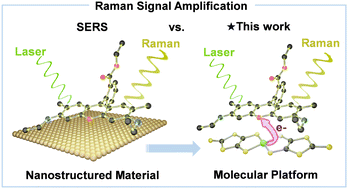
- This article is part of the themed collections: Journal of Materials Chemistry C HOT Papers and Journal of Materials Chemistry C Emerging Investigators 2026
 Please wait while we load your content...


