


 PLATFORM UPDATE:


Stretchable, self-healable, and adhesive ionogels formed via dual association of complex copolymers
 *a
and
Myungwoong
Kim
*a
*a
and
Myungwoong
Kim
*a
Abstract
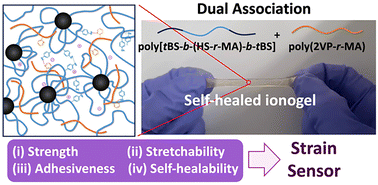
We report the fabrication of freestanding, stretchable, highly adhesive, ionically conductive, and self-healable ionogels consisting of an ionic liquid (IL) and two types of copolymers bearing hydrogen bonding acceptor and donor units: (i) poly[tert-butyl styrene-b-(4-hydroxystyrene-r-methyl acrylate)-b-tert-butyl styrene], and (ii) poly(2-vinyl pyridine-r-methyl acrylate). These copolymers yield an associative ionogel by forming micelles via IL-phobic interactions, and the micelles interact through hydrogen bonding between corona blocks, bridging by stretched block copolymer chains, or hydrogen bonding between the corona block and the additional pyridine-bearing copolymer chains. By tuning the molecular weights and compositions, we fabricated freestanding ionogels exhibiting outstanding mechanical properties, including a strain at break of ≈1000%, toughness of ≈3000 kJ m−3, and Young's modulus of ≈300 kPa, along with an ionic conductivity of ≈0.5 mS cm−1. The ionogel adheres strongly to various substrates—such as plastics, elastomers, glass, and metals—with a maximum adhesion stress of ≈1300 kPa under ambient conditions. It remains adhesive even in water and demonstrates a self-healing efficiency greater than 95%. When applied as a strain sensor, the ionogel exhibits a highly linear and reversible strain–resistance response, with a gauge factor of 1.9 over a strain range of 10–100%, showing negligible hysteresis, rapid recovery, and stable performance under cyclic loading. The sensor also demonstrates exceptional self-healing capability and long-term durability, fully restoring its electrical response after complete severing and maintaining consistent signal output under 50% strain for over 20 000 s, confirming its suitability for reliable soft sensing applications.
 Please wait while we load your content...


