


 PLATFORM UPDATE:


Chirality-guided crystal packing for tunable clustering-triggered emission

Abstract
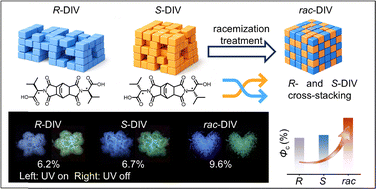
Nonconventional luminophores possess unique optical properties governed by the clustering-triggered emission (CTE) mechanism, yet rational regulation of their crystal packing to minimize nonradiative decay remains a significant challenge. Herein, we report a stereochemical engineering strategy to modulate the packing mode and lattice rigidity of imide-based nonconventional luminophores, thereby optimizing their photoluminescence (PL) and persistent room-temperature phosphorescence (p-RTP). Chiral model compounds (R/S-DIV) and racemic counterparts (rac-DIV) were synthesized via a straightforward amidation between the imide scaffold and chiral valine. Structural analysis revealed that while the bulky isopropyl group of valine induces steric repulsion and results in less efficient molecular packing within the homochiral lattice, the racemic crystal exhibits a significantly denser, alternating R/S cross-stacked architecture, consistent with Wallach's rule. This densified packing effectively restricts intramolecular motions and strengthens intermolecular interactions. Consequently, at room temperature, rac-DIV exhibits superior photophysical performance, achieving a quantum efficiency (Φc) and phosphorescence lifetime (τp) approximately 1.5-fold and 4-fold higher, respectively, than those of its homochiral counterparts. These findings validate the pivotal role of stereochemistry in controlling molecular packing and offer a generalizable approach for developing high-performance nonconventional luminophores.
- This article is part of the themed collections: Journal of Materials Chemistry C HOT Papers and New Developments in Photofunctional Materials and Transformations
 Please wait while we load your content...


