


 PLATFORM UPDATE:


Capillary-filling-regulated direct soft imprint lithography for coffee-ring- and residue-free stacked-layer patterning

Abstract
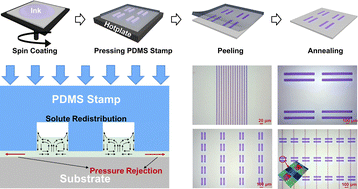
Direct soft imprint lithography (DSIL) is a simple, high-resolution, and low-cost patterning alternative to photolithography. However, the imprint residues, thickness nonuniformity, and overlay printing problems of DSIL limit its practical applications. Here, we report a capillary-filling-regulated DSIL strategy that enables high-fidelity, residue-free, and coffee-ring-free stacked-layer patterning. Through capillary filling regulation, a 2-methoxyethanol (2-ME)/ethylene glycol (EG) co-solvent ink was formulated to tune the ink properties, ensuring sufficient ink filling in plasma-treated PDMS stamp microchannels. We develop a simplified quantitative framework to link ink properties and stamp wettability to the filling behavior during imprinting. The proposed framework is consistent with the experimental results and enables thickness-tunable patterning. Furthermore, evaporation-driven solute-transport analysis supports a solute-redistribution mechanism that suppresses the coffee-ring effect, while EG eliminates imprint residues by delaying solidification. Finally, this method is employed to fabricate stacked-layer thin-film transistors (TFTs) with ITO electrodes and In0.8Ga0.2Ox active layers, achieving mobilities up to 5.1 cm2 V−1 s−1. This simple and low-cost DSIL strategy provides a broadly applicable route for high-precision stacked-layer patterning in printed electronics and microelectronic integration.
 Please wait while we load your content...


