


 PLATFORM UPDATE:


Charge carrier transport and trap levels in solution-processed Zn(ii) Schiff base OLEDs
 *a
Rodrigo
Araujo Mendes,
b
Luís Gustavo Teixeira Alves
Duarte,
c
Fabiano Severo
Rodembusch,
d
*a
Rodrigo
Araujo Mendes,
b
Luís Gustavo Teixeira Alves
Duarte,
c
Fabiano Severo
Rodembusch,
d
Abstract
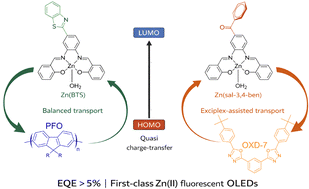
Organic light-emitting diodes (OLEDs) are a leading display technology, yet achieving high efficiency in first-class fluorescent OLEDs remains a challenge due to limited internal quantum efficiency (IQE). In this study, we report a comprehensive investigation of Zn(II) Schiff base coordination compounds as first-class fluorescent emitters embedded in solution-processed active layers based on poly(9,9′-dioctylfluorene) (PFO). To enhance charge-carrier balance and device performance, two strategies were employed: (i) introduction of a TPBi electron-transport layer (ETL) and (ii) incorporation of the n-type material OXD-7 into the PFO matrix, forming an exciplex host. Devices fabricated from both room-temperature and hot solutions were characterized. Electroluminescence spectra revealed near-white emission due to efficient energy transfer between the host and guest materials. Charge-transport analysis using space-charge limited current (SCLC) models revealed that hot processing increases trap densities (NT), while OXD-7 incorporation reduces NT under cold processing. Among the emitters, Zn(BTS) and Zn(sal-3,4-ben) showed the highest device efficiencies in PFO and PFO:OXD-7 matrices, respectively, achieving current efficiencies up to 10.48 cd A−1 and EQEs exceeding 6%. The results demonstrate improved charge balance and reduced roll-off behavior, linking electrical and optical properties through quantitative trap-state analysis and electronic mobility estimations. This study provides a route to high-performance, cost-effective near-white OLEDs based on Earth-abundant Zn(II) coordination complexes.
 Please wait while we load your content...


