


 PLATFORM UPDATE:


Ionic–electronic transport interplay sustaining composition-tolerant terahertz absorption in organic mixed conductors

Abstract
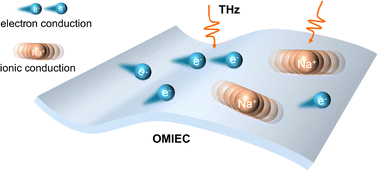
Organic mixed ionic–electronic conductors (OMIECs) offer additional degrees of freedom for tailoring terahertz (THz) electromagnetic responses beyond purely electronic materials, yet the role of ionic–electronic transport interplay in THz absorption remains insufficiently understood. Here, we choose poly(3,4-ethylenedioxythiophene):poly(styrenesulfonate) (PEDOT:PSS)-based OMIEC thin films as the model system and systematically investigate their THz absorption behaviors. Despite pronounced redistribution of electronic and ionic transport properties, the THz absorption remains nearly invariant across a wide compositional window, exhibiting a stable high-absorption level (∼50% on average over 0.2–1.2 THz). This behavior can be consistently rationalized by a compensated Drude–Debye response, in which variations in electronic conduction are counterbalanced by changes in ionic relaxation. Meanwhile, the OMIEC films maintain high visible transparency (>85%) and stable THz performance over a broad temperature range (20 °C to 120 °C). These results highlight ionic–electronic transport interplay as a key design consideration for composition-tolerant, ultrathin, and transparent THz absorbers.
 Please wait while we load your content...


