


 PLATFORM UPDATE:


An interfacial electric field strategy for improving the performance of perovskite X-ray detectors
 d
Shihe
Yang
*ab
d
Shihe
Yang
*ab
Abstract
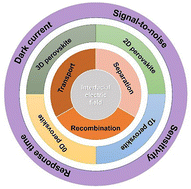
X-ray detection technologies are indispensable tools across diverse fields including medical diagnostics, industrial inspection, environmental monitoring, and security screening. Emerging perovskite materials are prospective substitutes for traditional ones to develop high-performance X-ray detectors, which are distinguished by their large atomic numbers, configurable bandgap, better charge carrier mobility, and extended carrier diffusion length. However, perovskite X-ray detectors still face challenges in achieving high sensitivity, low detection limits, quick reaction times, and long-term operating stability. The main cause of these problems is the use of ineffective strategies for the creation, separation, transport, collection, and recombination minimization of photogenerated charge carriers. Notably, the charge carrier dynamics in perovskite X-ray detectors are fundamentally driven by an interfacial electric field (IEF). Therefore, a comprehensive and deep understanding of IEF's crucial role in the performance of perovskite X-ray detectors is of paramount importance in the rational design of perovskite X-ray detectors. In this review, we first elucidate the basic principles of IEF formation at various interfaces within perovskite detector devices and the profound impact of IEF on enhancing the charge separation efficiency, promoting carrier transport, and suppressing recombination pathways, ultimately reducing dark current and improving signal-to-noise ratio. Subsequently, we systematically summarize the recent advances in modulating the IEF through various strategies including heterojunction engineering, energy level alignment via interfacial dipole layers and functional layer modifications. Finally, perspectives are given on the existing challenges and future opportunities in IEF engineering, aiming to stimulate a new fundamental understanding and guide the rational design of high-performance perovskite X-ray detectors.
- This article is part of the themed collection: Journal of Materials Chemistry C Recent Review Articles
 Please wait while we load your content...


