


 PLATFORM UPDATE:


Silica-reinforced dual-network ionogel fibers with excellent mechanical properties for wearable alternating current electroluminescent devices
 *a
*a
Abstract
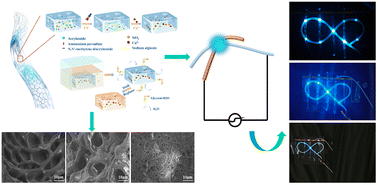
Wearable displays, considered the ultimate platform for human-body information acquisition and processing, demand conformable and versatile form factors that conventional planar and rigid technologies cannot satisfy. The recent advancement of flexible electronics has spurred significant research into fibrous devices that integrate high stretchability, excellent electrical conductivity, and stable luminescence performance. While ionogels are promising candidates due to their superior ionic conductivity and biocompatibility, their limited mechanical properties hinder practical applications under complex deformation. To address this challenge, this study introduces silica (SiO2) nanoparticles into a sodium alginate–polyacrylamide (SA–PAM) based ionic gel matrix to fabricate organic–inorganic hybrid gel fibers with enhanced mechanical properties and high ionic conductivity. The effects of the SiO2 nanoparticle size (12, 50, and 300 nm) and content (0.25 wt%–2 wt%) on the fiber's optical transmittance, electrical conductivity, and tensile performance were systematically investigated. The results revealed that the fiber incorporating 0.5 wt% of 12 nm SiO2 nanoparticles exhibited optimal comprehensive performance, achieving an optical transmittance of 83%, an electrical conductivity of 7.87 S m−1, and a tensile strain of over 1600%. An alternating current electroluminescent (ACEL) device constructed with this fiber demonstrated a luminous intensity of 339 cd m−2 under 80 V and 1000 Hz conditions. Furthermore, it maintained stable operation under 200% tensile strain and enabled multi-pixel pattern display. This research provides a novel strategy for balancing mechanical and electrical performance in wearable luminescent devices, thereby advancing the development of high-performance wearable display applications.
- This article is part of the themed collection: Journal of Materials Chemistry C HOT Papers
 Please wait while we load your content...


