


 PLATFORM UPDATE:


350 ps Ultrafast room-temperature scintillation realized on CsPbBr3-based single crystals via Br2 over-doping

Abstract
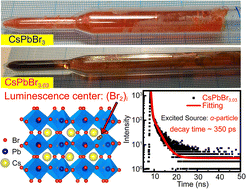
Ultrafast scintillators are essential for next-generation radiation detection, positron emission tomography, and high-speed medical imaging. All-inorganic CsPbBr3 perovskites are attractive candidates because of their high stopping power, and excellent optical quality, yet their long carrier lifetimes result in slow scintillation responses on the order of hundreds of nanoseconds. Here, we demonstrate that controlled over-doping with Br2 produces CsPbBr3.03 single crystals with sub-nanosecond scintillation at room temperature while preserving crystal quality. Single crystals grown by the Bridgman method exhibit high transparency and maintain the orthorhombic perovskite structure. Br2 over-doping induces a slight lattice expansion (about 0.42% increase in unit-cell volume) while maintaining the orthorhombic perovskite phase and high optical transparency. Optical absorption reveals a slight redshift of the absorption edge after Br2 introduction, indicating a modified defect landscape. Time-resolved photoluminescence and radioluminescence measurements show that Br2 doping creates dense and efficient recombination centers that reduce the scintillation decay time from more than 100 ns in undoped crystals to 350 ps under 5.486 MeV α-particle excitation, and the scintillation decay time decreases by two orders of magnitude. The doped crystals also achieve a spatial resolution of 12 lp mm−1 in X-ray imaging. These results reveal a defect-engineering route for achieving ultrafast scintillation in halide perovskites and highlight the potential of Br2-modified CsPbBr3 for fast timing applications.
- This article is part of the themed collection: Journal of Materials Chemistry C HOT Papers
 Please wait while we load your content...


