


 PLATFORM UPDATE:


Magnetic structure of layered Co2B2O5 and the role of the bridging B2O5 anions in three-dimensional magnetic ordering
 *a
Yu. S.
Gokhfeld,
a
N. V.
Kazak,
a
S. M.
Zharkov,
ab
A. S.
Tarasova,
a
V. V.
Sokolov
a
and
S. G.
Ovchinnikov
a
*a
Yu. S.
Gokhfeld,
a
N. V.
Kazak,
a
S. M.
Zharkov,
ab
A. S.
Tarasova,
a
V. V.
Sokolov
a
and
S. G.
Ovchinnikov
a
Abstract
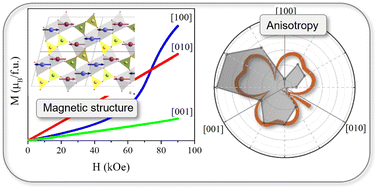
Single crystals of pyroborate Co2B2O5 have been synthesized using a flux method and characterized using X-ray diffraction, scanning electron microscopy, and thermogravimetric, magnetic and optical measurements. Direction-dependent magnetization measurements were carried out. At low temperatures, the Co magnetic moments align antiferromagnetically in the ac-plane. When a magnetic field is applied along the a-axis, a spin-flop transition takes place. The room-temperature optical absorption edge is Eg = 4.20 eV. The crystal, electronic, and magnetic structures were studied using density functional theory combined with representation analysis. The calculations predict that the ground magnetic state is collinear antiferromagnetic described by the propagation vector k = (0, ½, ½), where the ferromagnetic layers built of the Co2+O6 octahedra separated by [B2O5]4−-groups are antiferromagnetically coupled. The Co magnetic moments are aligned along the [101] direction and nearly lie in the plane of [B2O5]4−-groups. The multiple collinear and noncollinear magnetic structures with k = (0, 0, 0), (½, 0, 0), and (0, ½, ½) lie in the close vicinity of the ground magnetic state and could be stabilized by the external magnetic field and temperature. The calculations of the exchange interactions revealed the crucial role of the exchange paths via bridging [B2O5]4− anions in the long-range magnetic order.
 Please wait while we load your content...


