


 PLATFORM UPDATE:


Polymorph-triggered multiple responses in dynamic molecular crystals of barbituric acid derivatives

Abstract
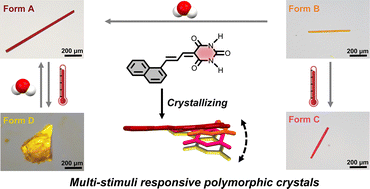
Achieving controllable, dynamic polymorphism and integrated multi-stimuli responses in rigid organic molecules without flexible molecular regulators is challenging. This work reports four polymorphs (Forms A, B, C, and D) of (E)-NAPT, a rigid, conjugated molecule constructed from a barbituric acid moiety and a naphthalene unit, linked by a divinyl linker. Our findings demonstrate that the crystallization environment dictates the hydrogen-bonding saturation state of the terminal barbituric acid units, forcing the backbone to transition from planar to bent and dictating distinct packing modes. Form A adopts a layered packing stabilized by a water molecule-bridged saturated hydrogen-bonding network. In contrast, Form D maintains a saturated hydrogen-bonding motif but lacks stress-relieving water molecules, leading to a trigonal pyramidal packing. Forms B and C exhibit comparable one-dimensional hydrogen-bonding arrays assembled via offset head-to-head stacking. These structural variations directly encode multi-stimuli responsiveness. Heating transforms Form A into Form D via dehydration with a fluorescence switch, a process reversible by solvent vapor. Form B displays dual pathways: conversion to Form A via vapor or irreversible thermal transition to Form C, triggering macroscopic mechanical motions. This conformational bending within the rigid framework also translates to their photoresponsive properties. In Form A, the plane conformation provides the reactive sites with ideal parallel alignment and proximity, enabling reversible photochromism. This work elucidates that manipulating molecular conformational strain by tuning the hydrogen-bonding networks effectively “encodes” complex phase-transition pathways and multi-stimuli responsiveness into rigid molecular frameworks, offering a new paradigm for the rational design of dynamic crystalline materials.
- This article is part of the themed collection: New Developments in Photofunctional Materials and Transformations
 Please wait while we load your content...


