


 PLATFORM UPDATE:


Pyrene-based non-doped blue hot-exciton OLEDs with hybrid local and charge-transfer states: achieving high efficiency and low efficiency roll-off

Abstract
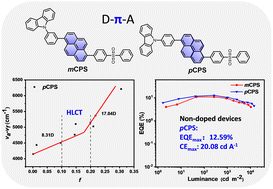
Fluorescent materials utilizing the “hot exciton” pathway can realize efficient reverse intersystem crossing (RISC) from high-lying triplet states (Tn), effectively suppressing non-radiative decay and triplet–triplet annihilation. In this work, two pyrene-based blue emitters (mCPS and pCPS) with isomeric structures were designed and synthesized. These emitters possess a small S1–T2 energy splitting, which is beneficial for efficient T2 → S1 reverse intersystem crossing. Benefiting from the hot-exciton effect, the non-doped organic light-emitting diode (OLED) based on pCPS yields a maximum external quantum efficiency (EQEmax) of 12.59%, a maximum current efficiency (CEmax) of 20.08 cd A−1, and an exciton utilization efficiency of 77.7%. Impressively, the device exhibits a remarkably low efficiency roll-off of only 16.60% at a practical luminance of 1000 cd m−2. Magneto-electroluminescence and transient electroluminescence measurements confirm that the excellent device performance arises from the hot-exciton mechanism, rather than the triplet–triplet annihilation process. This high-efficiency and low-roll-off performance is among the best reported for non-doped pyrene-based blue hot-exciton OLEDs, demonstrating that the “hot exciton” pathway is a feasible and effective strategy for constructing high-performance blue fluorescent emitters.
 Please wait while we load your content...


