


 PLATFORM UPDATE:


Multilayer interfacial engineering of Al–Ce metallic glass for brittleness mitigation and reliable motion sensing

Abstract
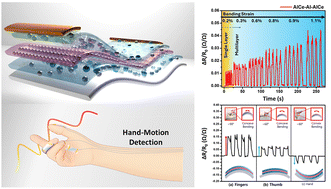
Metallic glasses (MGs), recognized for their high strength and broad elastic limits, are promising candidates for next generation flexible electronics. Nevertheless, their implementation in strain sensors is constrained by their inherent brittleness arising from localized shear banding. In this study, Al–Ce (AlCe) MG and crystalline Al thin films were alternately deposited to create a multilayered structure engineered to suppress shear band propagation and address this limitation. Strain sensor devices fabricated with this architecture displayed substantially enhanced performance, including an extended working strain range of 1.1% and improved signal linearity relative to single layer amorphous or crystalline electrodes. Indentation analyses conducted under progressively increasing loads on the AlCe–Al–AlCe multilayer demonstrated that localized stress and brittle failure were effectively suppressed, accompanied by improved strain sensing. Overall, this study demonstrates that incorporating this multilayered structure offers a viable strategy for designing ductile and reliable MG based strain sensing electrodes.
 Please wait while we load your content...


