


Hollow ZnO/C nanospheres with defect engineering for enhanced dielectric loss and broadband electromagnetic wave absorption

Abstract
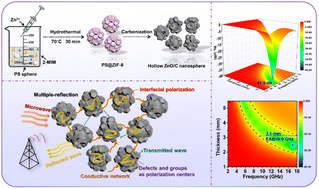
Efficient electromagnetic wave (EMW) absorption requires the synergistic optimization of dielectric loss and impedance matching, which remains challenging for dielectric absorbers. Herein, ZnO-doped carbon hollow nanospheres (ZnO/C) featuring hierarchical porosity and defect-rich architectures are rationally constructed via the pyrolysis of polystyrene-templated ZIF-8. The synergistic effects of sacrificial template removal and controlled framework decomposition give rise to well-defined hollow cavities, multilevel porous carbon shells, uniformly dispersed ZnO nanodomains, and abundant intrinsic defects. The hollow architecture effectively tailors the overall permittivity, thereby optimizing impedance matching, while heterogeneous interfaces, defect-induced dipoles, and interconnected conductive networks collaboratively enhance dielectric loss through interfacial polarization, dipole relaxation, and conduction loss. Benefiting from this integrated structural and defect regulation, ZnO/C-2–800 delivers an effective absorption bandwidth (EAB) of 9.0 GHz at a thickness of 3.1 mm, fully covering the X–Ku band, whereas ZnO/C-5–800 achieves a minimum reflection loss (RLmin) of −41.9 dB at 8.0 GHz. These results highlight hollow MOF-derived architectures with engineered defects as an effective strategy for high-performance EMW absorbers.
- This article is part of the themed collection: Journal of Materials Chemistry C HOT Papers
 Please wait while we load your content...


